Europe runs out of its own oranges in May, and somebody has to fill the shelf. For decades that somebody has been the Southern Hemisphere, and within it South Africa built the most complete counter-seasonal citrus export machine on the continent. The industry’s scale is a worked example of how a developing-country agricultural sector wins a premium Northern market, but the structural tension underneath it is sharper than the success suggests: the same European demand that built the South African industry is also being filled, ever more cheaply, from the southern shore of the Mediterranean.
The Anchor: The Third-Largest Horticultural Industry
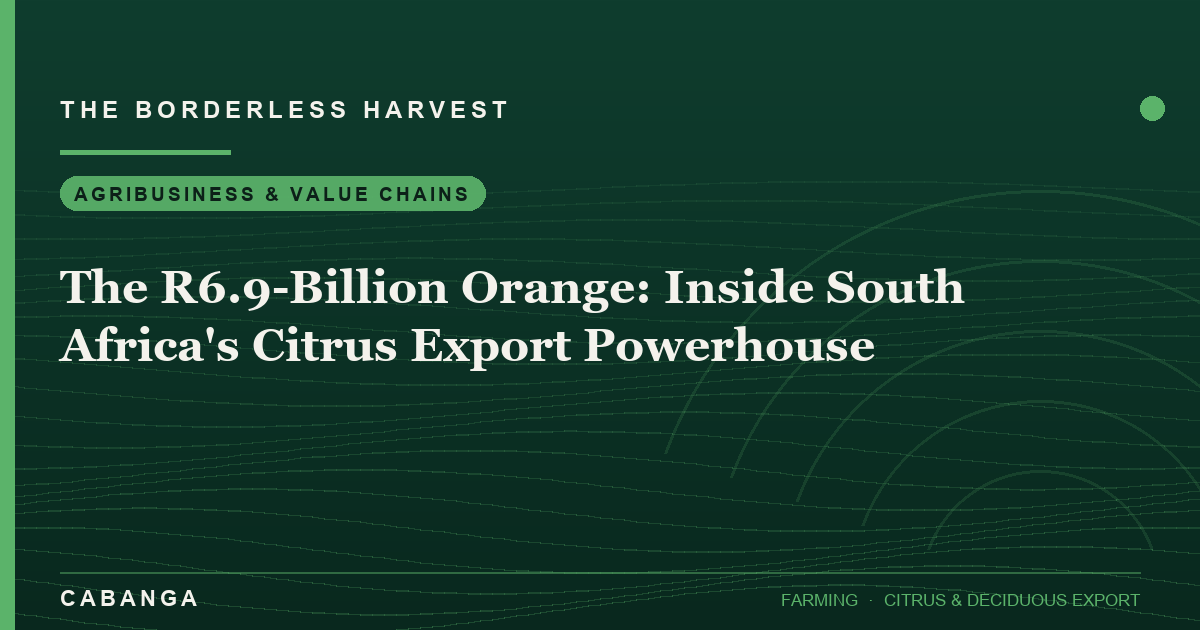
Citrus is South Africa’s third-largest horticultural industry. It contributed R6.9 billion, roughly nineteen percent of horticultural gross value of production, in 2010/11, and it is overwhelmingly export-oriented rather than aimed at the domestic market. Those figures are a 2010/11 baseline and should be refreshed against current data before print, but the structural point they capture has only deepened: South African citrus is a foreign-exchange earner first and a domestic crop second. The Citrus Growers’ Association of Southern Africa, the industry’s coordinating body, exists precisely because an export industry of that size needs collective infrastructure no single grower could build, from market access negotiation to research levies. When nearly a fifth of horticultural value sits in one export-facing crop, the industry’s institutions matter as much as its orchards.
Takeaway: South African citrus is not a crop the country eats, it is a crop the country sells.
The Comparators: Rebuilders And Cost Leaders
The comparator field splits cleanly into two stories. Zimbabwe and Eswatini are the rebuilders. Both have real citrus heritage and agronomic suitability, Eswatini in particular has long supplied counter-seasonal fruit, but both face the harder task of rebuilding or sustaining export capacity against the capital intensity that modern citrus demands. Then there are the cost leaders. Egypt and Morocco are not rebuilding anything; they are out-competing. Both sit on the Mediterranean with a freight advantage to Europe that no Southern Hemisphere grower can match, and both have scaled production aggressively. The FAOSTAT production series and ITC Trade Map flows show the North African origins climbing the European supply ranks. The threat to South African citrus is not its Southern African neighbours; it is the Mediterranean.
The distinction matters for how each comparator should read the South African example. For Zimbabwe and Eswatini the relevant lesson is constructive: South Africa is a template of what a counter-seasonal exporter can build from a standing start, and the gap between them is one of infrastructure and institutions rather than agronomy or season. For Egypt and Morocco the relationship is competitive, and the lesson runs in the other direction, because they are already demonstrating a cost-and-proximity model that South Africa cannot copy back. A single crop, then, sits inside two entirely different comparisons at once.
Takeaway: one set of comparators wants what South Africa has, the other already takes part of it.
The Mechanism: Cold Chain, Association, Protocol
The South African citrus machine runs on three interlocking pieces of infrastructure, and the export simply does not happen without all three. The first is the cold chain: an unbroken temperature-controlled path from orchard to packhouse to port to European retailer that preserves both quality and the phytosanitary integrity the destination demands. The second is the grower association itself, the CGA, which pools the costs of research, market access and standards that individual growers could never carry. The third is phytosanitary access, the formal protocols negotiated with the South African Department of Agriculture and accepted by the European Union, which determine whether the fruit may legally enter at all. Cold chain moves the fruit, the association funds the system, and the protocol opens the border. Remove any one and the R6.9 billion does not exist.
It is worth dwelling on why the grower association is doing economic work, not merely administrative work. Citrus for export is a research-intensive and standards-intensive business: rootstock and varietal development, residue compliance, market intelligence and the slow government-to-government negotiation of access protocols all carry costs that no individual grower could justify alone but that every grower needs paid. By pooling levies, the CGA converts a collective-action problem into a funded institution, and that is the part of the South African model least visible from the orchard and most decisive to the outcome. The cold chain and the protocol are tangible; the association is the connective tissue that keeps both financed and negotiated season after season.
Takeaway: South African citrus is an infrastructure achievement first and an agricultural one second.
The Comparator Verdict: Proximity Beats Counter-Seasonality
The honest verdict has two halves. For Zimbabwe and Eswatini, rebuilding a citrus export industry is realistic but conditional, and the condition is the full infrastructure stack, not the orchards. Suitable land and growing knowledge are necessary and nowhere near sufficient. Without cold chain to port, a body that performs the CGA’s coordinating function, and negotiated phytosanitary access to a premium market, fruit may grow but it cannot be exported at scale. Eswatini’s existing counter-seasonal pedigree gives it the shorter path; Zimbabwe’s is longer and gated by the same capital and logistics constraints that shadow its wider agriculture.
For Egypt and Morocco, the verdict cuts the other way, and the series owes its readers candour about it. On cost and proximity to Europe, they out-compete South Africa, and they do so structurally rather than temporarily. A grower a few days’ freight from Rotterdam, with lower labour and logistics costs, holds an advantage that quality and reliability can defend against but not erase. South Africa’s answer has been counter-seasonality, supplying Europe precisely when the Mediterranean cannot, and that window remains its strongest moat. But where the seasons overlap at the margins, North African cost leadership shows. This is one of the clearest cases in the whole series where the template does not automatically win.
Takeaway: South Africa’s moat is the calendar, not the cost line.
The Forward Action: What Must Be In Place
For a Zimbabwean or Swazi policymaker, investor or agribusiness owner, the sequence is not negotiable. Build the cold chain to a working port first, because it gates everything downstream. Establish or strengthen a grower association that can fund research and negotiate market access collectively, since no single exporter can carry those costs. And invest in the phytosanitary compliance, traceability and pest-management systems that a premium destination requires before, not after, seeking access, because the protocol is the actual border. For South Africa, the forward action is to defend the counter-seasonal window with reliability and to compete on quality and traceability where it cannot compete on freight cost.
The series thesis closes this piece with unusual clarity. South Africa is the template for how to build a counter-seasonal citrus export powerhouse, and its cold chain, its grower association and its hard-won phytosanitary access are the worked example Zimbabwe and Eswatini should study line by line. But the template is to be improved upon as much as emulated: Egypt and Morocco already beat South Africa on cost and proximity to Europe, and that inversion is exactly the kind the series exists to state plainly. South Africa is the continent’s most complete citrus model, not its permanent champion, and the orchard that learns both halves of that lesson, the infrastructure to emulate and the cost frontier to beat, is the one that fills the European shelf next.