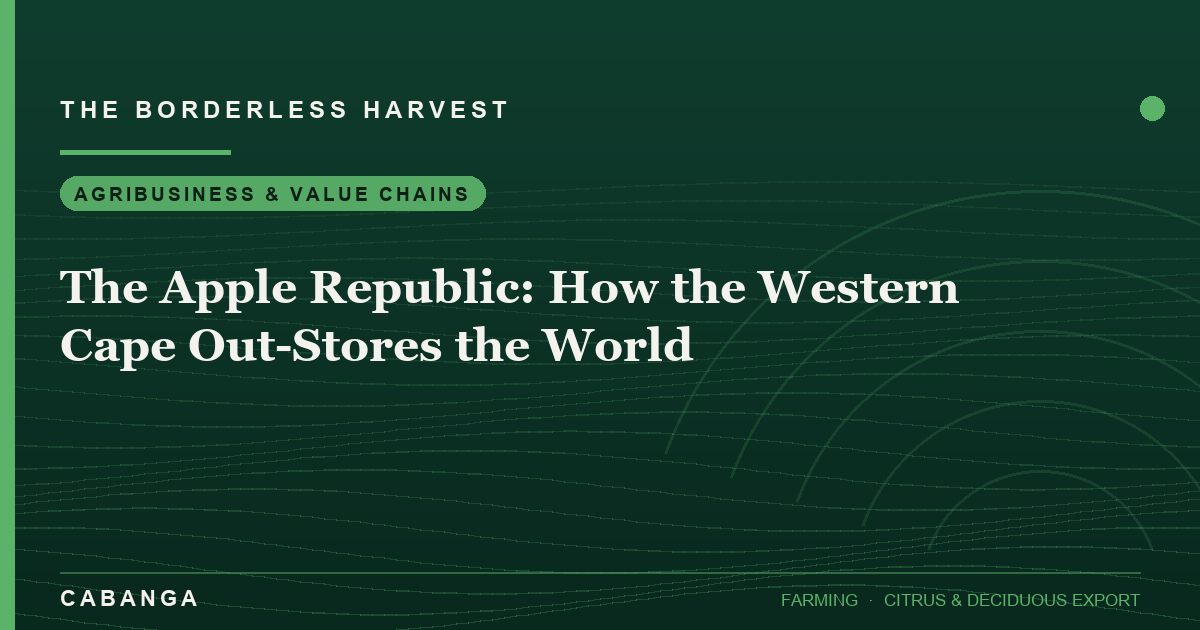
An apple’s competitive advantage is not grown — it is stored. The fruit that leaves Ceres or Elgin for a European shelf in the southern winter may have been picked months earlier, and the months in between are where the money is made or lost. This is the quiet truth of the pome-fruit business: the orchard sets the ceiling, but the store decides whether you ever reach it.
South African pome fruit — apples and pears — is a major Western Cape export industry built on two things the rest of the continent struggles to assemble together: a cold-winter agro-ecology that gives the trees the chilling hours they need, and controlled-atmosphere storage capital that lets the fruit be held for months and sold into northern-hemisphere counter-seasonality, the structure documented by Hortgro and South Africa’s Department of Agriculture (industry structural baseline; verify current tonnages before print).
The Mechanism: Counter-Seasonality You Can Bank
The commercial logic is geographic arbitrage. When European orchards are bare in the southern summer, South African fruit fills the shelf; the producer who can deliver a crisp apple into that window earns a premium no domestic market would pay. But counter-seasonality only works if the fruit arrives in condition months after harvest, and that is the job of controlled-atmosphere storage — rooms where oxygen, carbon dioxide and temperature are held at levels that slow the fruit’s metabolism to near-dormancy.
Controlled-atmosphere storage is the apple industry’s equivalent of a strategic reserve. It converts a perishable, time-bound harvest into a product the grower can release on a schedule, smoothing supply across the export window and holding quality long enough to reach a distant market. The grower who controls release timing also controls exposure to price: fruit held in a controlled-atmosphere store can wait out a soft week and ship into a firmer one, a flexibility the fresh-only producer never has. It is also expensive, and that expense is the barrier to entry that keeps the field of serious counter-seasonal exporters small.
Takeaway: in pome fruit, whoever stores longest sells best.
The Comparators: Highlands With the Climate, Not Yet the Capital
The agro-ecology apples demand — cold winters, high altitude — exists in pockets across the region. Zimbabwe’s Eastern Highlands have the elevation and the chilling hours, and once supported a deciduous base; the gap is the storage and export infrastructure rather than the climate. Lesotho, almost entirely highland, has the cold-winter conditions in principle, but a commercial apple-export industry needs far more than suitable temperature: it needs orchards at scale, controlled-atmosphere capacity and a route to port.
Kenya’s highlands offer altitude, and the country has proven it can run export horticulture to a high standard, but apples sit awkwardly against its tropical-highland profile and its established strength in other crops. The pattern across all three is the same: the climate is the easy part. The cold-winter agro-ecology is necessary but nowhere near sufficient, because the binding constraint is the storage capital that turns a harvest into a year-round export.
Takeaway: the climate is widely shared; the controlled-atmosphere store almost never is.
The Verdict: A High-Capital Crop, Honestly Priced
Apples are a high-altitude, high-capital crop, and the honest verdict is that the capital is the gate. Establishing export orchards on elite cultivars, then building controlled-atmosphere storage to hold the crop, is a multi-year investment before the first premium consignment ships [TK — supplied anchor carries no establishment-cost figure; source per-hectare and per-store capex before print]. Global production context tracked by FAOSTAT shows how concentrated competitive apple supply is, and the concentration is no accident — it follows the storage capital.
What must be in place is the full pairing, in order: the cold-winter site, then the orchard, then the controlled-atmosphere store, then the export route. A highland with the right climate but no storage is a domestic apple industry at best. The Western Cape’s edge is not that it grows apples; it is that it out-stores the world.
Takeaway: build the store, or sell only at home.
South Africa’s Ceres-and-Elgin model is the template the continent’s highlands should read closely — not as an unreachable standard, but as a precise specification of what an apple-export industry costs. Zimbabwe’s Eastern Highlands hold the clearest potential to adapt it; Lesotho and Kenya have pieces of the puzzle but not yet the whole. South Africa is the worked example here — to be emulated where the storage capital can be raised, adapted to each highland’s conditions, and in time perhaps improved upon.