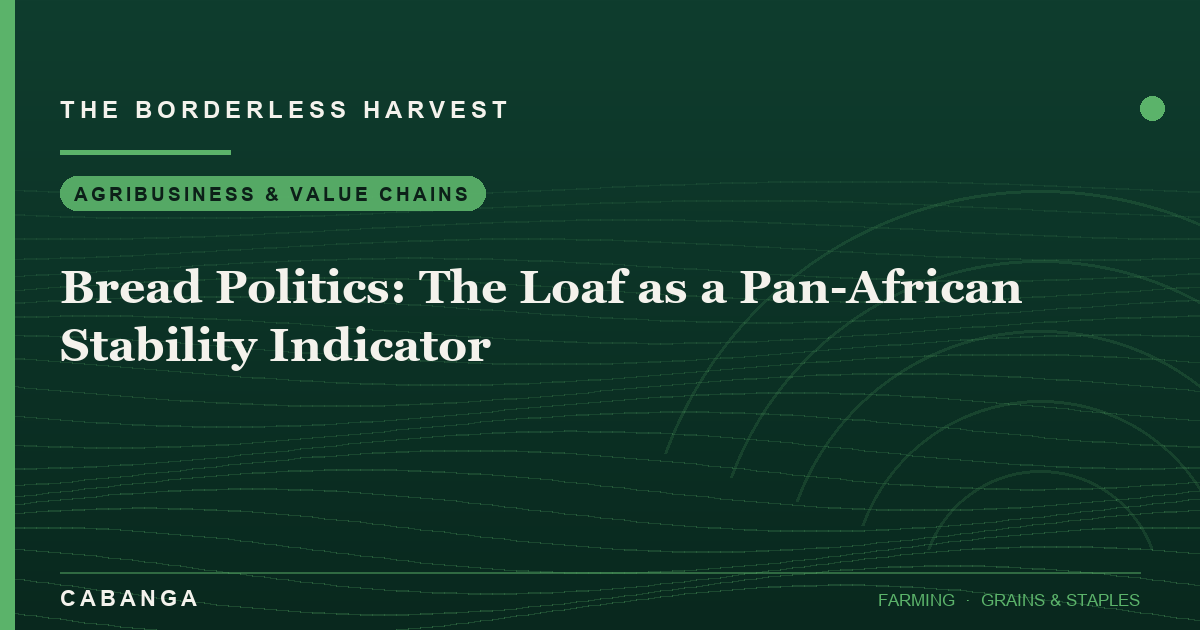
The price of bread is a political instrument disguised as a grocery item. When it moves sharply upward, governments fall — the historical record across North Africa and beyond is unambiguous. That makes the wheat-to-bread chain unlike almost any other commodity chain on the continent: its failures are measured not only in margins but in political stability. South Africa offers the structural reference point for how that chain is built, and how its pricing can quietly go wrong.
The anchor is South Africa’s politically sensitive bread chain. Wheat-to-bread in South Africa is a chain that has been repeatedly investigated for pricing collusion, with the National Agricultural Marketing Council among the bodies monitoring the structure and conduct of the staple-food value chain from milling through baking. The South African case demonstrates both how concentrated a bread economy becomes and why the regulator has to keep watching the millers and bakers who sit between imported wheat and the household loaf.
The Anchor: A Chain Built on Concentration
South Africa’s wheat-to-bread chain runs through a small number of large millers and major baking groups. That concentration delivers efficiency and consistent supply, but it also creates the conditions for coordinated pricing — which is why the chain has drawn repeated competition scrutiny. The structural lesson is that the bread chain naturally funnels toward a few powerful players, and a functioning state has to assume that funnel will be tested for abuse rather than trust that it will not.
The deeper point is exposure. Because South Africa imports a meaningful share of its wheat, the domestic bread price is tethered to two volatile variables it does not control: the global wheat price and the exchange rate. A strong harvest abroad and a firm rand keep bread stable; a global supply shock and a weak rand transmit straight to the loaf. The bread price is where world markets reach into a domestic kitchen.
Takeaway: A concentrated, import-linked bread chain imports its instability along with its wheat.
The Comparator: Egypt, Nigeria and Zimbabwe Exposed
The three comparators sit at different points on the exposure curve. Egypt is among the world’s largest wheat importers and operates one of its largest bread-subsidy programmes precisely because the political cost of a bread shock is existential there; its strategy is to absorb global price swings through the fiscus and strategic reserves rather than pass them to citizens. Nigeria is heavily wheat-import-dependent with a large, currency-sensitive population, leaving the naira price of bread acutely exposed to exchange-rate moves. Zimbabwe layers wheat-import dependence on top of chronic currency instability, the most fragile combination of the three.
The mechanism that separates resilience from fragility is policy cushioning. Data from the Food and Agriculture Organization and the World Bank’s agriculture and rural development indicators allow each country’s wheat-import intensity and price-shock exposure to be compared on a like-for-like basis. What turns exposure into a crisis — or prevents it — is whether a strategic grain reserve, a credible milling policy and a fiscal buffer stand between the world price and the shelf. Egypt has built that buffer deliberately and expensively; Zimbabwe has the least.
Takeaway: Bread stability is bought with reserves and fiscal buffers, not with luck.
The Mechanism: What Actually Cushions the Loaf
The honest verdict is that no import-dependent country can make its bread price immune to global shocks, but each can choose how much of the shock to absorb and where. A strategic wheat reserve buys time across a price spike. A competition authority with real capacity — the watching function South Africa exercises through bodies like the NAMC — ensures that when world prices fall, the saving reaches the consumer rather than being captured in the milling-to-retail margin. A fiscal buffer, as in Egypt, can subsidise the gap, though at a cost that competes with everything else a budget must do.
The instructive inversion is that Egypt, for all the expense, manages bread-price politics more deliberately than most — a reminder that South Africa is the structural template but not automatically the leader on every metric. On insulating the consumer from a wheat shock through reserves and subsidy, a heavy importer like Egypt has built tools South Africa has not needed to. The template is a reference, not a ranking.
Takeaway: Every government can choose where the wheat shock lands — on the budget, the margin or the household.
The Forward Action: Reserves, Competition Oversight, Currency Discipline
For a policymaker, the bread chain demands three things in place at once: a credible strategic reserve, a competition authority able to police the milling-to-retail margin, and currency discipline to blunt exchange-rate transmission. For an investor, the signal is that bread-chain margins are perpetually political and perpetually watched, and durable returns come from efficiency and supply security rather than from pricing power.
South Africa supplies the structural map of how a bread economy is built and where it must be policed; the comparators show how differently exposure is managed once that map is in hand. That combination — a template to study and inversions where neighbours do it better — is exactly the role South Africa plays across this series: the continent’s agricultural template, to be emulated, adapted, and in places improved upon.