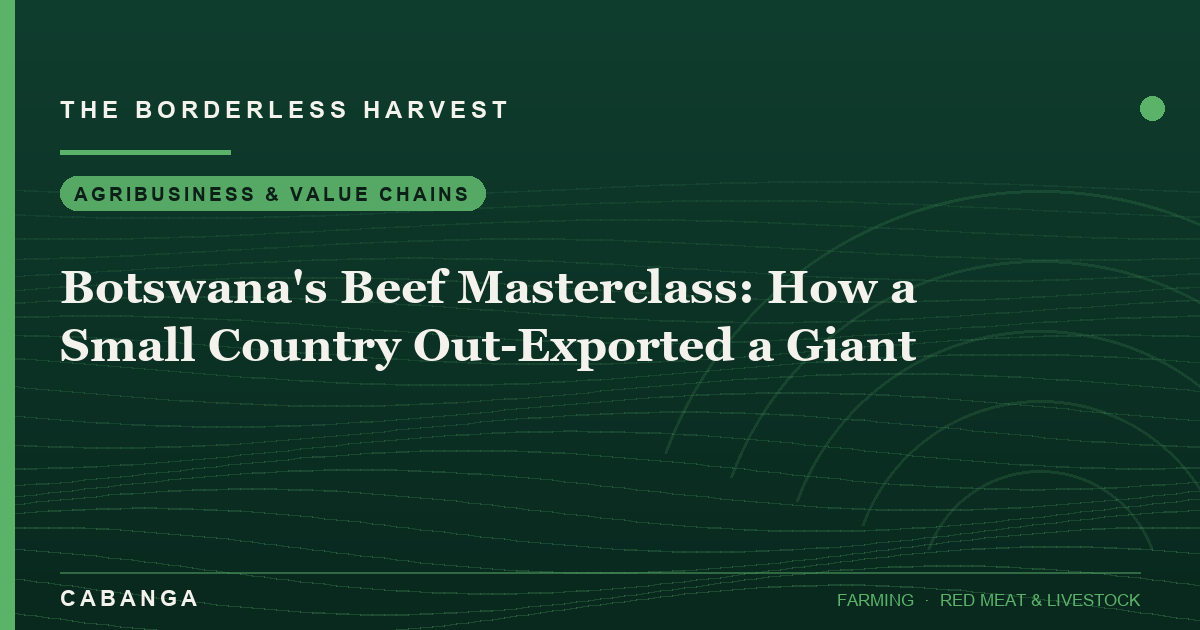
A country that is mostly desert sells beef to Europe; the regional giant next door largely sells to itself. South Africa’s beef is overwhelmingly consumed at home and lacks the traceability-driven European Union access its smaller neighbours secured years ago. That is the inversion worth reverse-engineering: how did Botswana, with a fraction of South Africa’s cattle, out-export the giant — and what does it reveal about the difference between owning a herd and owning a market?
Here South Africa is the student, not the teacher. Its larger herd has not bought it the premium export access that defines Botswana’s beef industry, because that access was never about scale. It was about building a system the export market would trust.
The Mechanism: A System Built Backwards From the Buyer
Botswana engineered its beef economy from the European buyer’s requirements inward. At the centre sits the Botswana Meat Commission (BMC), the long-dominant export channel through which the country routed its beef to high-value markets. Around it Botswana built the elements Europe demands: a national livestock identification and traceability system able to trace an animal back through its movements; veterinary disease zoning and cordon control to manage foot-and-mouth disease and certify clean zones; and an abattoir and cold-chain capacity audited to export standard. The result is that a Botswana carcass can answer the questions a European importer asks — where has this animal been, and can you prove it is disease-free — that much South African beef cannot. The Botswana Meat Commission anchored this model, and FAOSTAT trade data show how a small national herd converted into outsized export value.
Botswana did not build a bigger herd; it built a more believable one.
The Comparator Within the Comparator: Namibia’s Parallel Path
Namibia reached the same destination by a similar route. It paired rigorous animal identification and farm-level traceability with disciplined veterinary zoning and an unambiguous export orientation, placing its beef on European and other premium shelves despite an arid, low-density grazing base much like Botswana’s. The point is not that the two economies copied one another, but that they arrived at the same architecture because the European buyer’s requirements admit no shortcut: identify the animal, prove the zone, certify the chain. Two semi-arid, cattle-dependent economies thus turned their constraint — land good for little but grazing — into a specialised, high-value export trade and a dependable source of forex earnings, while the wetter, larger South African industry stayed anchored to its domestic market.
The twin lesson from Gaborone and Windhoek: aridity is not the barrier to premium beef; missing traceability is.
The Verdict: Why the Giant Never Matched the Model
The honest verdict is that South Africa never matched Botswana not because it could not, but because its structure pulled the other way. A large domestic market absorbed the beef, reducing the pressure to chase export compliance. A herd split heavily into communal and emerging holdings made nationwide animal-level traceability far harder to achieve. And persistent foot-and-mouth disease risk across parts of the country complicated the disease-zoning that EU access demands. None of these is insurmountable, but together they meant South Africa optimised for volume and home consumption while Botswana optimised for assurance and export. Regional trade analysis from tralac and national figures from Statistics Botswana underline how deliberately Botswana positioned beef as a forex-earning export pillar rather than a domestic staple.
The verdict: South Africa had every advantage except the one that mattered — a system built for the export buyer.
The Forward Action: Copy the System, Not the Size
What must be in place for any country wanting Botswana’s outcome is the sequence Botswana followed: animal-level traceability first, credible disease zoning second, export-grade abattoir and cold chain third, and a coordinating institution to hold the three together and represent the national product to overseas buyers. The cattle are the easy part; the assurance system is the hard, decisive part — and it is replicable by countries far larger than Botswana, South Africa included.
Botswana’s beef masterclass inverts the series’ usual direction: here the small country is the template and the giant is the learner. South Africa remains the continent’s most industrialised agricultural economy, but in premium beef export it has something concrete to emulate, adapt and finally improve upon — a model proving that in red meat, market access is built, not inherited.