The Needeye Review – Why Ground Truth Matters
African consumer markets continue to be interpreted through lenses that are often disconnected from lived experience. Institutional reports, aggregated datasets, and external advisory perspectives provide high-level insight, but they frequently fail to capture the operational mechanics of how consumers interact with markets on a daily basis. This disconnect is particularly evident in Southern Africa, where informal economies, infrastructure variability, and behavioural adaptation significantly influence consumption patterns.
The Needeye Review is designed to address this gap by prioritising direct observation over abstraction. It is grounded in retail census experience across multiple countries, combined with data analytics and sustained presence within consumer environments. The objective is not to validate existing narratives, but to observe how systems function in real time, at the level where economic activity is most visible and measurable.
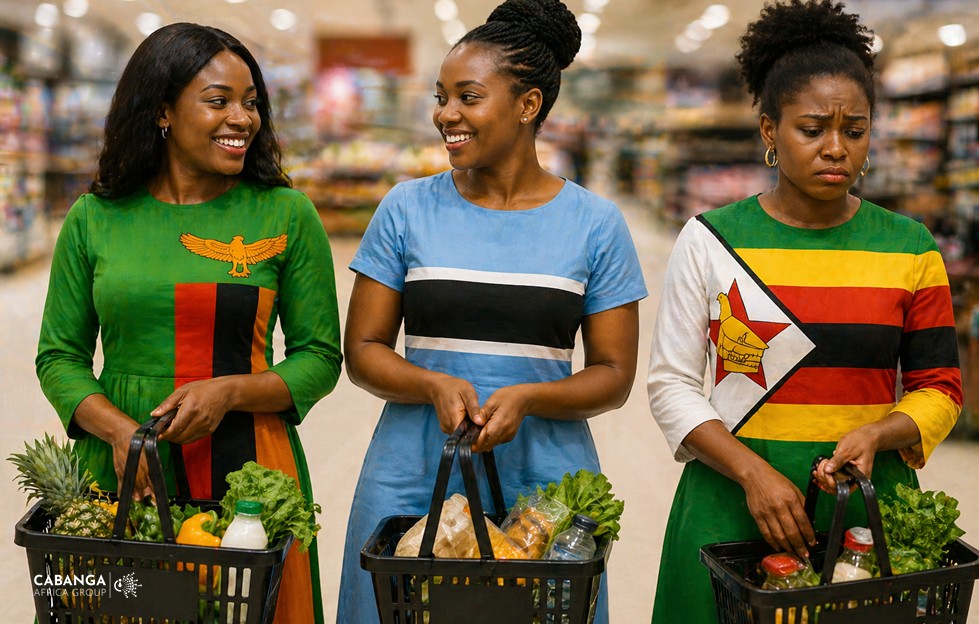
Over a thirty-day period, Zambia, Botswana, and Zimbabwe were assessed through this framework. The analysis focused on daily consumer behaviour, retail infrastructure, pricing structures, mobility systems, and the integration of formal and informal markets. Observations were made within malls, supermarkets, street-level retail environments, and transport networks, providing a comprehensive view of how consumers navigate their respective economies.
The findings reveal a clear divergence in consumer system functionality. Zambia is operating as a stable and expanding consumer economy with balanced structural variables. Botswana maintains a structured and predictable environment, though influenced by external systems. Zimbabwe, while active, is constrained by systemic pressures that limit the interaction between consumers and the market.
The 3As Framework: Affordability, Availability, Accessibility
To assess these markets with precision, the Needeye Review applies a three-variable framework that defines the strength of any consumer economy: affordability, availability, and accessibility. These variables must function together, as the absence or weakening of one directly impacts the effectiveness of the others.
Affordability is the relationship between pricing and consumer purchasing power. It determines whether consumers can participate consistently in the market without being forced into irregular or survival-based purchasing behaviour. It is influenced not only by income levels but by pricing strategies, inflation expectations, and cost structures embedded within the economy.
Availability measures the consistency of product presence within the market. A consumer economy cannot function effectively if goods are sporadic or dependent on unpredictable supply chains. Consistent availability supports stable purchasing patterns and reinforces consumer confidence.
Accessibility refers to the physical and logistical ability of consumers to reach goods. This includes infrastructure quality, transport systems, fuel costs, and the spatial distribution of retail environments. Even when goods are affordable and available, high access costs can significantly reduce effective purchasing power.
The interaction of these three variables determines whether a consumer economy operates as a participation system or a survival system. Zambia, Botswana, and Zimbabwe demonstrate distinct configurations of these variables, which define their current positions.
Zambia: The Benchmark Consumer Economy
Zambia currently operates as the most balanced consumer economy among the three, with a relatively stable alignment of affordability, availability, and accessibility. This balance positions it as the benchmark for comparative analysis.
Affordability is supported by pricing structures that reflect a volume-driven approach. Retailers appear to operate with confidence in consumer movement, setting prices that encourage turnover rather than defensive margin protection. This approach allows a broader segment of the population to engage consistently with FMCG products, including essential groceries and household items.
Availability is consistent across both formal and informal retail channels. Supermarkets are well-stocked, and supply chains appear stable at the consumer level. The diversity of products suggests an effective integration of imports and local production, with minimal visible disruption in distribution.
Accessibility is a critical strength. Infrastructure supporting retail zones, particularly in urban centres, is functional. Roads leading into malls and shopping districts are maintained at a level that supports movement, reducing friction in consumer access. Transport systems, including minibuses, Bolt, and Yango, provide multiple mobility options, ensuring that access is not limited to specific income groups.
The retail environment itself reinforces Zambia’s position. Malls are structured, curated, and comparable to those in South Africa, widely regarded as the continent’s most advanced retail system. However, Zambia distinguishes itself through the integration of local brands that operate at a high standard while maintaining local production. This reflects a maturing ecosystem that is not dependent solely on imported retail models.
Beyond transactional activity, Zambia is developing an experience-driven retail environment. Observations include large-scale interactive chess boards, live musical performances, and family-oriented installations such as in-mall trains. These features indicate that retail spaces are being designed to encourage extended consumer engagement, which is a marker of confidence in both spending power and economic stability.
Zambia’s consumer system is not only functional; it is evolving toward a more integrated and experience-oriented model.
Botswana: Structured but South Africanised
Botswana presents a stable and organised consumer environment, with strong performance across affordability and availability, and reliable accessibility in key retail zones. However, its structure is significantly influenced by South African retail systems.
Affordability remains consistent, with consumers able to access a wide range of FMCG products at predictable price points. Pricing reflects a stable market environment where supply chains are reliable and demand is consistent. This supports regular consumer participation without the volatility observed in more constrained systems.
Availability is equally stable. Retail shelves are consistently stocked, and product variety reflects a well-integrated supply system. Botswana’s smaller population size contributes to a more manageable distribution network, allowing for efficiency in product movement.
Accessibility is supported by maintained infrastructure in central business districts and shopping areas. Roads are functional, and transport systems provide sufficient coverage. Like Zambia, Botswana benefits from ride-hailing platforms in addition to traditional minibuses, enhancing mobility options.
The defining characteristic of Botswana’s retail environment is its alignment with South African systems. Mall structures, store layouts, and product offerings closely mirror those found in South Africa. This provides stability and predictability but limits the development of a distinctly local retail identity.
Despite this, Botswana’s consumer base demonstrates notable behavioural complexity. The diversity of spices and herbs available through informal vendors exceeds that of Zambia and Zimbabwe and, in some cases, surpasses South Africa. This suggests a consumer base that engages with food preparation at a more advanced level, indicating sophistication that is not fully captured by formal retail structures.
Botswana operates as a structured consumer system with external influence, supported by a consumer base that exhibits localised complexity.
Zimbabwe: A Constrained Consumer Economy
Zimbabwe operates under conditions that significantly constrain the interaction between consumers and the market. The issue is not the absence of demand but the structure through which demand must operate.
Affordability is severely compromised. FMCG products are priced at levels that are disproportionately high relative to consumer income. This pricing is driven by defensive strategies, where retailers anticipate future instability and price accordingly. The result is reduced consumption and limited participation.
Availability is inconsistent. While goods are present, the distribution system lacks the stability observed in Zambia and Botswana. Supply chains appear fragmented, and the market relies heavily on informal channels to maintain product flow.
Accessibility is the most critical constraint. Fuel costs are higher relative to Zambia and Botswana, despite Zambia’s fuel supply passing through Zimbabwe. This creates a structural inefficiency that increases the cost of movement for consumers. Higher transport costs reduce effective purchasing power and limit access to retail environments.
Retail infrastructure reflects these constraints. Many spaces referred to as malls lack the structure and cohesion of integrated retail environments. Instead, they function as corridors segmented into small stalls, offering a limited and fragmented shopping experience. The absence of curated retail spaces reduces consumer engagement to necessity rather than participation.
The informal economy dominates visible space, with vendors operating extensively without structured integration. This creates congestion and reduces the efficiency of urban environments.
Zimbabwe’s consumer system is active but structurally restricted, operating under conditions that limit full participation.
Pricing Psychology: Fear vs Scale
Pricing behaviour across these markets reveals underlying economic psychology. In Zambia and Botswana, pricing reflects confidence and continuity. Retailers operate on volume, expecting goods to move and consumers to return. This supports affordability and encourages participation.
In Zimbabwe, pricing reflects caution and uncertainty. Retailers price goods based on anticipated instability rather than current demand. This leads to elevated prices that suppress consumption, creating a cycle where limited movement reinforces high pricing.
Pricing, in this context, becomes an indicator of how a market perceives its own future stability.
Food Systems and Consumption Patterns
Food systems provide insight into broader economic structure. Zambia leads in beef quality, reflecting a strong agricultural base that translates directly into consumer value. Botswana also offers high-quality beef but remains influenced by South African systems.
Zimbabwe shows relative strength in organic chicken availability, indicating resilience in specific segments despite broader constraints. However, overall variety is limited.
Botswana’s spice diversity indicates a more complex consumer palate, while Zambia maintains balance. Zimbabwe’s variety is constrained by systemic limitations.
Retail Experience as an Economic Signal
Retail environments reflect economic confidence. Zambia’s malls are integrated spaces that combine commerce, leisure, and cultural expression. Botswana’s environments are structured but externally influenced. Zimbabwe’s retail spaces are fragmented, reflecting broader system constraints.
Retail experience is an indicator of how an economy values consumer participation.
Informal Economy Integration vs Overflow
In Zambia and Botswana, informal vendors are integrated into formal retail environments, reducing congestion and supporting coexistence. In Zimbabwe, informal activity dominates without structure, overwhelming infrastructure.
The issue is not informality, but lack of integration.
Consumer Mobility and Logistics
Mobility defines access. Zambia and Botswana provide relatively stable systems, while Zimbabwe’s high fuel costs and infrastructure strain increase the cost of movement, limiting participation.
Accessibility is determined by cost efficiency, not just distance.
The Real Gap: Time, Not Potential
The differences between these markets reflect system progression. Zambia operates at a mature level, Botswana follows with structural strength, and Zimbabwe trails due to system disruption.
Zimbabwe is approximately ten years behind Zambia, while Botswana is three to five years behind.
The Consumer Economy Defines the Real Economy
The true measure of an economy lies in how consumers live, move, and engage with markets. Zambia demonstrates a functioning system, Botswana maintains structured participation, and Zimbabwe operates under constraint.
The future of these economies will be determined by how their consumer systems evolve, as retail, logistics, and pricing behaviour shape economic outcomes.
 WhatsApp for a Google-Ready Website